---
title: "Qualified Opportunity Zones (QOZ) 2.0: Opportunity to Zone-In on Capital Gains Savings"
description: "Qualified Opportunity Zones 2.0: Opportunity to Zone-In on Capital Gains Savings"
image: https://blog.bakerave.com/hubfs/qoz%20blog(1).png
---
[](https://www.bakerave.com/)
- [Wealth](https://www.bakerave.com/wealth)
- |
- [Investments](https://www.bakerave.com/investments)
- |
- [Insights](https://www.bakerave.com/insights-impact)
- |
- [About](https://www.bakerave.com/about)
- |
- [FAQs](https://www.bakerave.com/faqs)
- |
- [Contact](https://www.bakerave.com/contact)
- |
- [schedule](https://www.bakerave.com/schedule)
- [Login](https://bd3.bdreporting.com/Auth/Baker/SignIn)
[Tax Planning](https://blog.bakerave.com/blog/tax-planning)
# Qualified Opportunity Zones (QOZ) 2.0: Opportunity to Zone-In on Capital Gains Savings
Share
[](http://www.linkedin.com/shareArticle?mini=true&url=https://blog.bakerave.com/blog/qualified-opportunity-zones-2.0-opportunity-to-zone-in-on-capital-gains-savings)
[](https://www.facebook.com/sharer/sharer.php?u=https://blog.bakerave.com/blog/qualified-opportunity-zones-2.0-opportunity-to-zone-in-on-capital-gains-savings)
[](https://twitter.com/intent/tweet?text=I+found+this+interesting+blog+post&url=https://blog.bakerave.com/blog/qualified-opportunity-zones-2.0-opportunity-to-zone-in-on-capital-gains-savings)
Key QOZ Updates for 2026 and Beyond
---
Qualified Opportunity Zones (QOZs) have offered investors a meaningful way to defer and, in certain cases, reduce capital gains taxes, all while supporting long-term community investment. As we approach the scheduled sunset of the original QOZ framework at the end of 2026 and look ahead to a newly updated version beginning in 2027, this is an ideal time to revisit your strategy and understand how the rules are evolving.
### The End of QOZ 1.0
If you invested in a QOZ under the original rules (available from 2017 through 2025), the capital gain you deferred will be recognized for tax purposes on December 31, 2026. That date is fixed, regardless of when you originally invested.
Because that tax liability is now firmly on the horizon, it's worth being thoughtful about the rest of 2026. Losses harvested during the year can help offset the reinstated gain, but losses realized after year-end cannot be carried back. That makes 2026 an important window for proactive tax-loss planning.
### What QOZ 2.0 Introduces in 2027
Beginning on January 1, 2027, the Qualified Opportunity Zone program shifts into a new, permanent version often referred to as QOZ 2.0. While the spirit of the program remains the same, several key updates aim to make the incentives clearer, more consistent, and more effectively targeted.
1\. Re-designation of Qualifying Census Tracts
Perhaps the most notable change is that states are required to re-designate eligible zones every ten years. This refresh helps ensure that capital continues flowing to the communities the program is meant to support based on current economic data, rather than decade-old census information. Eligibility standards are tighter, focusing capital more precisely on distressed communities.
2\. Rolling Five-Year Deferral Window
Another important update is the introduction of a rolling five-year deferral window. Under QOZ 1.0, everything was tied to the December 31, 2026 deadline. Under QOZ 2.0, gains invested in a Qualified Opportunity Fund (QOF) are deferred for five years from the date of investment, with no cliff date or compressed timeline. This restores meaningful time-value-of-money benefits for investors considering new opportunities after the program resets.
3\. Basis Step-Ups and Rural Incentive Enhancements
The updated structure also includes a clear basis step-up, which reduces the amount of the deferred gain that will eventually be taxable. For standard QOFs, the increase in basis on the deferred gain is 10% after five years, reducing taxable gains to 90% of the original amount. For qualifying rural funds (formally called Qualified Rural Opportunity Funds, or QROFs), the basis increase is even more generous at 30%, reducing taxable gain to 70%. These rural funds also benefit from a more flexible improvement requirement, which is intended to make development more feasible outside major metro areas.
QROFs must invest primarily in qualifying rural opportunity zone property. Beyond the more generous 30% basis step-up, rural projects receive a more achievable substantial improvement requirement. Instead of needing to improve a property by 100% of its basis, as required in many urban or standard QOZ projects, rural funds must meet only a 50% improvement threshold. This lower bar is intended to reflect the practical realities of rural development and make these projects more accessible and economically viable.
4\. 10-Year Tax-Free Appreciation
Crucially, one of the most compelling features of the original program remains unchanged: if an investor holds their QOF investment for at least 10 years, all post-investment appreciation is entirely exempt from federal capital gains tax. This preserves the most powerful feature of the original program: tax-free long-term compounding.
5\. Compliance and Reporting
Enhanced annual reporting requirements and meaningful penalties increase transparency and reinforce institutional credibility under the revised framework, particularly as funds, businesses, and investors will now be subject to more detailed data disclosures and stricter compliance oversight. This added structure is intended to address gaps identified in the original program while improving confidence in how Opportunity Zone capital is deployed.
### Tax Impact Comparison: QOZ 1.0 vs. QOZ 2.0
Financial Illustration ($1,000,000 Capital Gain Example)
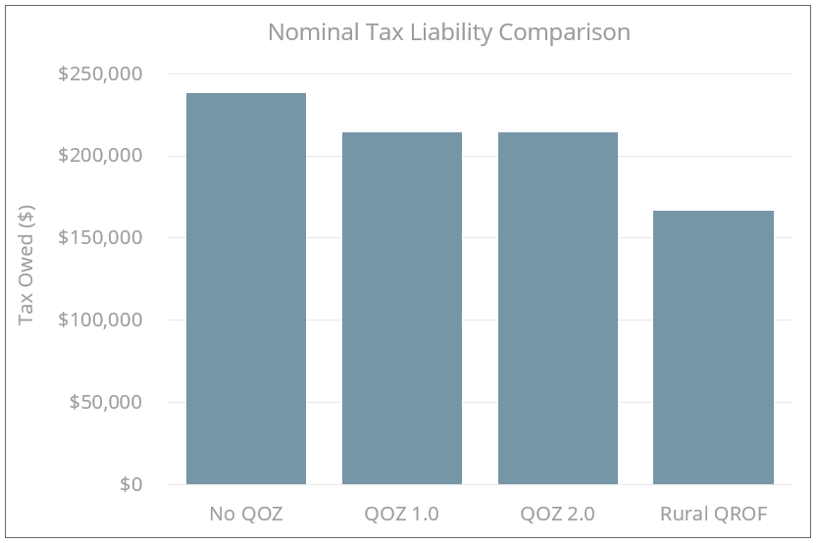
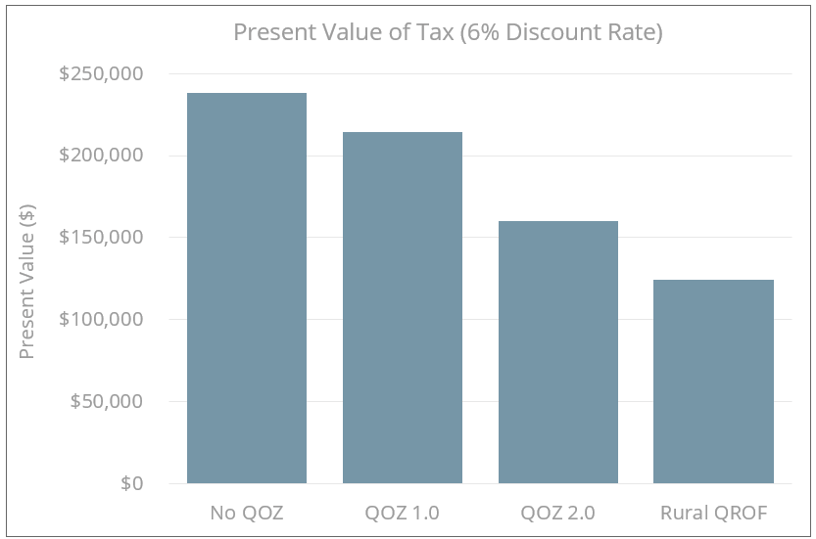
Using a $1,000,000 capital gain as an example, the differences between a standard tax outcome, a QOZ 1.0 investment, and the new QOZ 2.0 incentives become much easier to appreciate. The following chart illustrates these differences:
| **Scenario** | **Taxable Gain** | **Tax Owed** | **Present Value (6%)** |
| --- | --- | --- | --- |
| No QOZ Investment | $1,000,000 | $238,000 | $238,000 |
| QOZ 1.0 (Invest 2026) | $900,000 | $214,200 | $214,200 |
| QOZ 2.0 Standard QOF | $900,000 | $214,200 | $160,063 |
| QOZ 2.0 Rural QROF | $700,000 | $166,600 | $124,493 |
Assumptions: $1,000,000 long-term capital gain, 23.8% federal rate, 6% discount rate.
Chart 1: Nominal Tax Liability Comparison
Assumptions: $1,000,000 long-term capital gain, 23.8% federal rate, 6% discount rate.
Chart 2: Present Value Comparison
Assumptions: $1,000,000 long-term capital gain, 23.8% federal rate, 6% discount rate.
Without a QOZ investment, the full $1,000,000 gain is immediately taxable, resulting in $238,000 of federal tax. QOZ 2.0 with its rolling deferral and enhanced rural incentives, can offer more flexibility, more long-term benefit, and a more meaningful time-value advantage. For investors with significant capital gains and long-duration horizons, the updated framework provides meaningful after-tax compounding advantages.
### What This Means for Your Planning
The upcoming transition offers an opportunity for both reflection and preparation. For those with existing QOZ 1.0 positions, 2026 is a planning year: managing the reinstated gain thoughtfully can help reduce its impact. For those who have capital gains to redeploy in the future, QOZ 2.0 presents a refreshed incentive structure designed to be more durable and more flexible over time.
### Client Considerations
For clients who previously deferred a capital gain into a QOZ under the original QOZ 1.0 regime (applicable to tax years 2017 through 2025), that deferred gain will be deemed realized on December 31, 2026. Tax losses harvested during 2026 may be used to offset the reinstated gain, but losses realized after year-end cannot be carried back. To help manage the impact, BakerAvenue recommends maintaining or establishing an active tax-loss harvesting account. Some clients may also wish to consider large charitable-giving strategies in 2026, such as contributing to a Donor Advised Fund, to help reduce taxable income in the recognition year.
If you would like to explore a new QOZ investment or discuss planning for the gain reinstatement from a QOZ 1.0 investment, please reach out to your Advisor.
You can [contact BakerAvenue](https://www.bakerave.com/contact) to discuss how these changes fit into your broader tax-planning strategy and determine the next steps that are right for you.

#### Gerry O'Connell, Enrolled Agent, Tax Planning Partner
[Follow me on my website](https://bakerave.com/team/gerry-oconnell-enrolled-agent) [Follow me on LinkedIn](https://www.linkedin.com/in/gerald-o-connell-enrolled-agent-20628820/)
Gerry O'Connell is Tax Planning Partner and an Enrolled Agent (EA), the premier tax accreditation recognized by the IRS. Areas of special interest include estate planning strategies, retirement planning, real estate tax minimization and US reporting of assets held overseas.
BL=https://www.bakerave.com/insights-impact/blog\_enteries?t=qualified-opportunity-zones-2.0-opportunity-to-zone-in-on-capital-gains-savings